
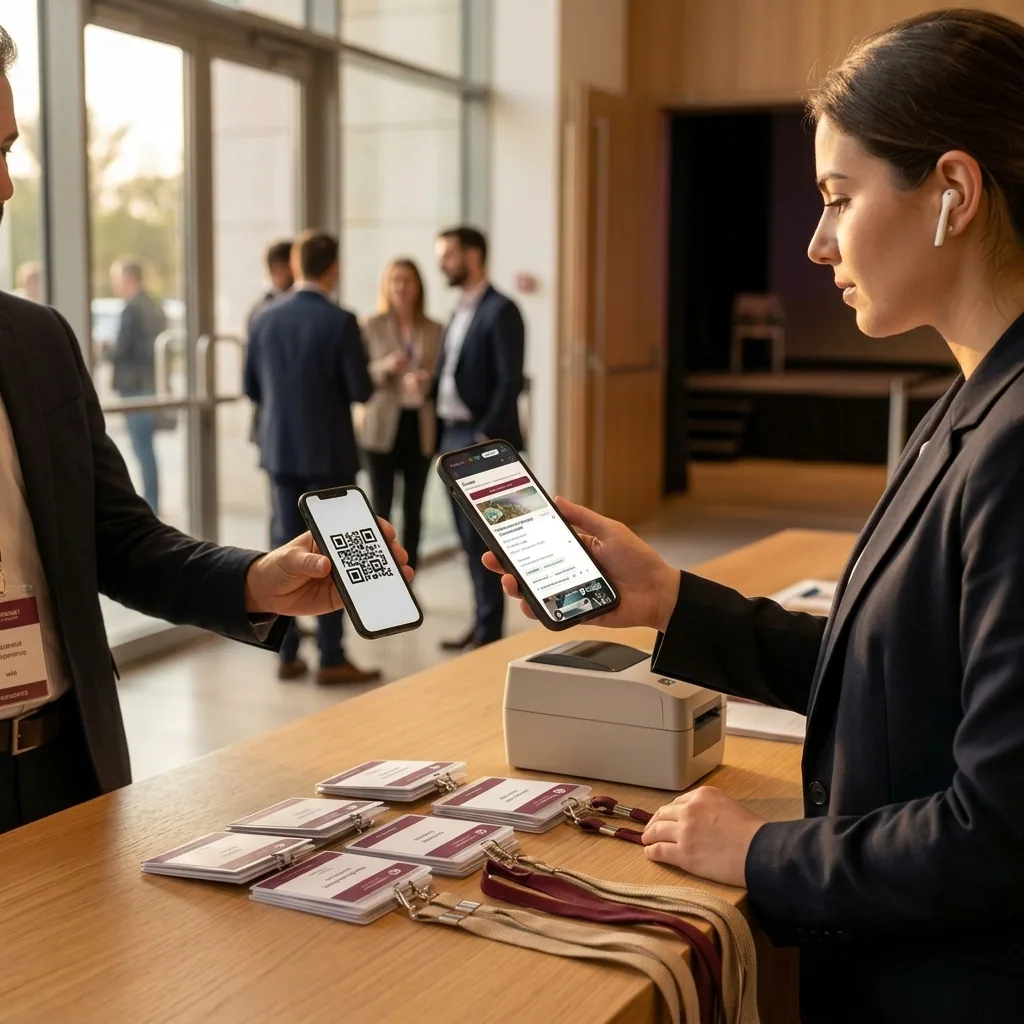
Conference check-in is the verification and credentialing workflow that identifies registered attendees, delivers personalized digital passes, and validates physical entry at business events. By synchronizing guest lists, automated messaging pipelines, and cloud-based QR code scanners, event production teams eliminate multi-version spreadsheets and manual phone calls. This architecture delivers entry throughput speeds of under three seconds per guest, guarantees hall capacity control, and generates instant attendance records with a single click.
At conferences hosting hundreds or thousands of participants, conference check-in serves as the operational spine of the entire production. Food and beverage commitments, badge printing runs, session room capacities, and welcome desk staffing allocations all depend directly on the accuracy of this data pipeline.
The Data Model: From Spreadsheet Drift to a Central Source of Truth
Corporate event management frequently begins with spreadsheet files shared across email threads or team messaging channels. Within days, version divergence creates operational friction: marketing retains one list, production teams manage another, and venue personnel hold a third. This misalignment surfaces immediately at the entrance, where late registrants are missing from printed rosters, VIP guests are directed to standard lines, and total headcounts become unreliable.
Migrating event operations to a centralized relational database ensures that every participant record maintains a persistent Unique ID. This data structure tracks:
- Personal profile and credential tier: Full name, job title, company name, and badge category (attendee, speaker, sponsor, or operational staff).
- RSVP status: Invited, confirmed, declined, or unconfirmed.
- Operational attributes: Dietary restrictions, breakout session tracks, and VIP parking allocations.
- Access token: An encrypted, unique uniform resource identifier generating an individual verification code.
When every touchpoint—registration landing pages, automated messaging gateways, and front-desk check-in terminals—reads from and writes to the same central database, record updates propagate immediately. If an attendee confirms attendance sixty minutes before doors open, their record surfaces instantly on staff scanning devices.
Event Registration and Ticket Distribution: WhatsApp and SMS Automation
Manual calling campaigns to secure attendee confirmations are cost-prohibitive and misaligned with executive expectations. Business attendees require low-friction interactions during standard work hours. Scheduled dispatches of a digital invitation for corporate events with single-click confirmation buttons yield significantly higher response rates and verified headcounts.
Direct messaging via the official WhatsApp Business Platform API provides reliable delivery and preserves enterprise branding without carrier blocking risks. This distribution pipeline operates in three structured phases:
- Initial invitation cycle: Dispatched ten to fourteen days before the event, providing an agenda overview alongside one-click confirmation and decline actions.
- Headcount lock reminder: Dispatched 48 hours prior to start time to non-respondents, establishing binding headcounts for catering and plenary room seating layouts.
- Digital credential issuance: Dispatched on the morning of the conference. This message provides a digital ticket designed to prevent venue queues, containing a personalized QR code, navigation links, and parking instructions.
Delivering credentials through instant messaging channels ensures guests do not need to search through crowded email archives upon arrival. The credential remains accessible on mobile screens as attendees approach the registration area.
Entrance Operations and QR Scanning: Eliminating Bottlenecks
Peak registration congestion at business summits occurs within a 45-minute arrival window. Manual name lookups on printed paper or typed laptop searches require 30 to 45 seconds per attendee. Across an arrival cohort of 300 guests, this latency creates extensive lobby queues, delays the opening plenary session, and creates negative initial impressions.
Adopting two-dimensional barcodes compliant with the ISO/IEC 18004 standard decreases verification time to under three seconds. Mobile cameras or dedicated industrial scanners decode the encrypted token, check validation rules against the local cache, and display visual and acoustic clearance confirmations on staff screens.
| Operational Metric | Manual Name Lookup | Dedicated QR Scanning |
|---|---|---|
| Average check-in time per attendee | 30–45 seconds | 2–3 seconds |
| Lane capacity per hour | 80–120 attendees | 800–1,200 attendees |
| Duplicate entry risk | High (human error in check-offs) | Zero (system blocks re-scans) |
| Paper documentation dependency | Complete (printed manifests) | Zero (paperless digital scanning) |
| Multi-lane synchronization | Not possible without manual aggregation | Continuous real-time cloud synchronization |
Maintaining continuous lane operation requires an offline-first cache architecture. If venue Wi-Fi networks degrade or cellular frequencies saturate during peak crowd arrival, scanning terminals continue validating codes locally on the device, queueing records, and syncing back to the cloud as connectivity restores.
On-Demand Badge Printing and Production Desk Integration
Professional conferences require branded attendee badges displaying full names, corporate affiliations, and access roles. Pre-printing thousands of badges prior to event day leads to congested sorting tables, unclaimed lanyards, and an inability to accommodate last-minute delegate substitutions.
Modern entrance setups integrate verification scanners directly with on-site thermal printers over a local area network. Once a valid QR code scans at the greeting desk, a print payload executes automatically. Within two seconds, the thermal device outputs a durable badge ready for immediate lanyarding, removing manual data entry entirely.
Before opening registration lanes, technical teams should execute standard preparation protocols. Running through mandatory checks before doors open confirms network stability, paper roll reserves, scanner battery charge levels, and failover switch functionality.
Real-Time Attendance Dashboards for Event Producers and Stakeholders
Event producers routinely manage critical questions from corporate sponsors and organizers: how many guests have checked in, whether the executive committee has arrived, and when the keynote session can safely begin. Centralized administrative dashboards resolve these operational queries in real time:
- Live entry velocity: Dynamic timeline charts displaying check-ins per minute, indicating whether arrival rates justify commencing the main plenary.
- Category-based segmentation: Real-time breakdown of general attendees, strategic clients, press, and VIP guests.
- VIP entry push notifications: Instant alerts routed directly to executive coordinators the moment high-priority guests scan at the perimeter.
At event conclusion, the automated system eliminates hours of manual data reconciliation. Instead of consolidating disparate paper rosters, operational leads can instantly generate an instant event attendance report for clients detailing entry timestamps, turnout percentages against confirmed RSVPs, and structured no-show registries for post-event follow-up campaigns.
To upgrade your next business event with automated registration workflows, dynamic badge printing, and real-time attendance analytics, connect with our technical operations team for a full infrastructure review.
Common questions
How far in advance should conference registration open?
Conference registration campaigns should launch four to six weeks before the event date to establish baseline interest. Targeted RSVP confirmation sequences should execute seven to ten days prior to the conference, followed by a digital credential delivery containing the entry QR code dispatched on the morning of the event to keep passes easily accessible.
How do check-in kiosks function during an internet outage?
Production check-in software utilizes an offline-first data model. Attendee authorization databases cache locally on scanning terminals prior to registration, allowing cryptographic QR code validation to execute locally in milliseconds. When internet connectivity restores, the software pushes queued entry timestamps back to the central database to maintain multi-terminal sync.
What happens if an attendee arrives without their QR code?
Registration desks retain a secured administrative lookup console allowing staff to locate attendee records by full name, phone number, email address, or corporate organization. Once identified, operators execute a manual one-tap check-in, which marks the attendee present and immediately invalidates the associated digital QR code against duplicate entry.
From the blog
Keep reading
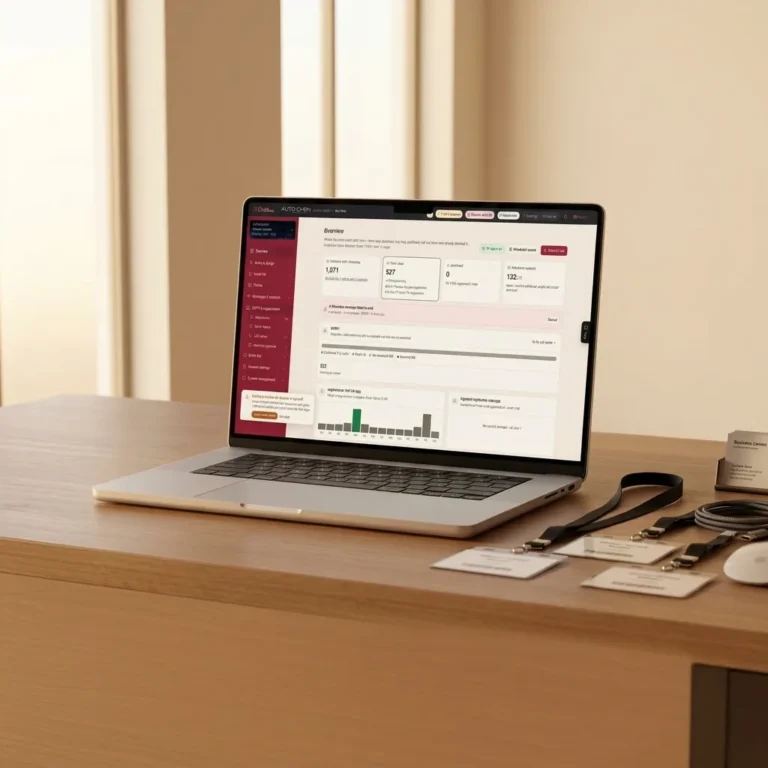
Branded Event Registration System: White-Label Control Without Monthly Fees
Deploy a white-label branded event registration system with pay-per-message pricing. Streamline RSVP tracking, guest QR codes, and entry operations.
Guest List Freeze: How to Manage Last-Minute Changes in Corporate Events
Learn when to enforce a guest list freeze for corporate events, how to handle last-minute attendee updates, and how cloud sync prevents check-in failure.

Real-Time Attendance Tracking: Entrance Control and Event Zoning
Deploy real-time attendance tracking and zoning across event gates. Learn how offline-first sync, access control, and dynamic capacity prevent bottlenecks.