
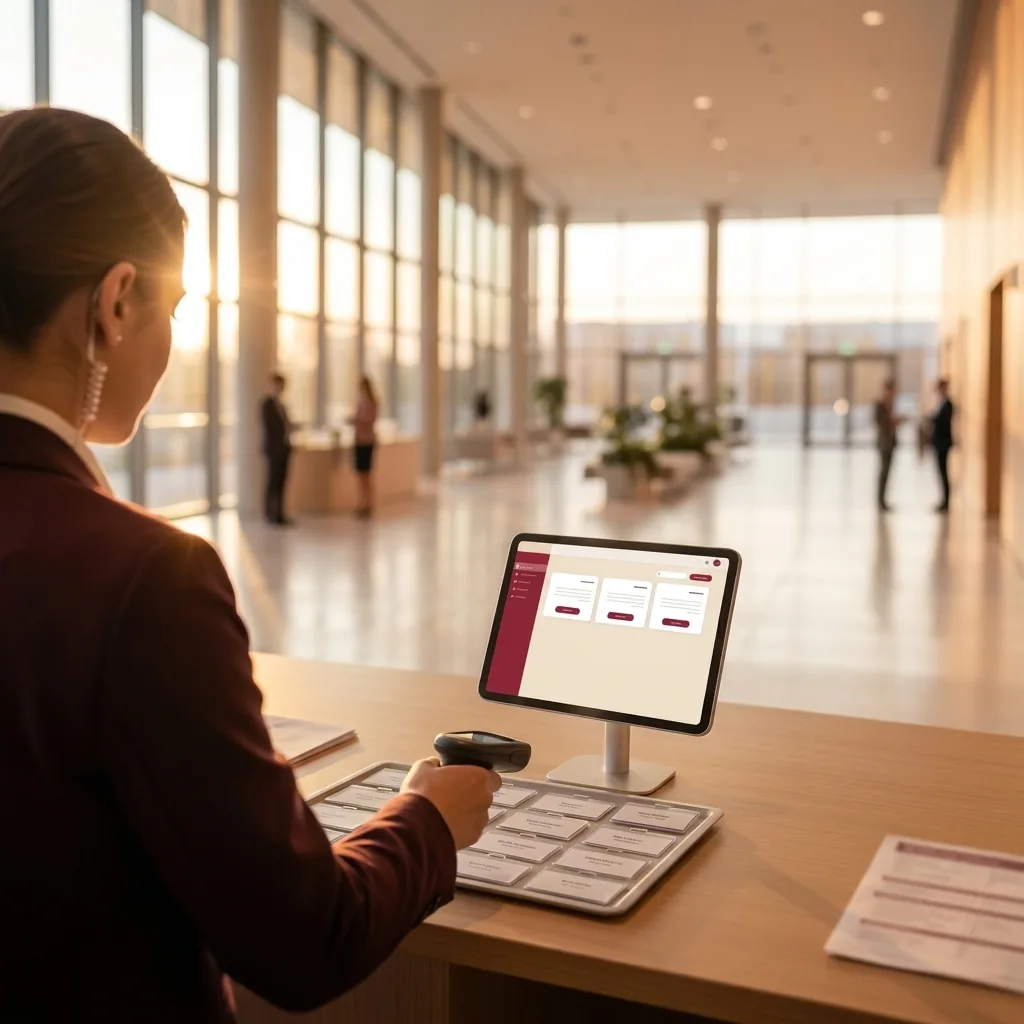
Effective conference check-in management requires strict operational separation between rapid verification and exception handling, local-first offline database synchronization, and disciplined guest list change freezes. Processing hundreds or thousands of attendees within a tight 45-minute arrival window cannot depend on staff typing speed; it requires a purpose-built operational architecture that compresses per-guest transaction times to 3 to 5 seconds. By applying structured desk workflows, redundant edge infrastructure, and centralized change control, event production teams guarantee immediate attendee ingress without delays.
Conference check-in management is the end-to-end operational, logistical, and technical framework responsible for verifying attendee credentials, issuing identification badges or credentials, and directing guest flow into the venue without physical bottlenecks. When this process degrades, arrival queues spill outside the venue footprint, keynote sessions face mandatory delays, and early attendee sentiment suffers significant friction.
—
1. Role-Based Desk Architecture: Decoupling Scanning from Exception Handling
The most pervasive operational failure in venue entrance design is treating every check-in station as an ad-hoc customer service desk. When an attendee arrives with an unconfirmed registration, a misspelled badge record, or an unpaid corporate invoice, an unsegregated station freezes for two to five minutes. With ten attendees queued behind them, that single transaction cascades into an aggregate delay of thirty minutes for the entire lane.
High-throughput production protocols enforce a strict division of labor across physical lanes:
- Fast-Track Verification Stations (Scan and Go): Stations restricted entirely to optical QR code scanning, instant local authorization, badge or kit distribution, and immediate attendee progression. The target transaction window is under 5 seconds per guest.
- Dedicated Help Desk (Exception Routing): A segregated station located completely outside the primary ingress vector, staffed to resolve name mismatches, ticket transfers, on-site registrations, and billing discrepancies.
Deploying standardized 2D symbologies based on GS1 2D barcode standards ensures hardware scanners decode high-density registration payloads instantaneously, regardless of attendee mobile screen glare or low display brightness. Successful deployment of this operational flow relies on structured conference RSVP and check-in workflows built on deterministic digital identifiers.
| Station Type | Target Duration | Permitted Actions | Prohibited Actions |
|---|---|---|---|
| Fast-Track Scan Station | 3–5 seconds | QR scanning, pre-printed badge handoff | Manual database lookups, data updates, payment handling |
| Scan and Print Station | 7–10 seconds | QR scanning, local thermal printing, badge handoff | Registration disputes, badge re-encoding, credential modifications |
| Exception Help Desk | 60–180 seconds | Email lookups, on-site card processing, identity resolution | Processing attendees carrying valid, readable barcodes |
—
2. Hybrid Network Architecture: Resilience and Local-First Synchronization
Subterranean exhibition halls, heritage hotels, and high-density convention centers frequently experience intermittent cellular reception and severe Wi-Fi saturation when hundreds of attendees connect their devices simultaneously. Any entry management setup that executes synchronous remote HTTP queries for every scan introduces latency spikes or complete operational gridlock.
To prevent network outages from breaking queue flow, the registration infrastructure must run on a local-first model where device runtimes execute queries against local storage engines. Built according to MDN offline web application standards, resilient check-in clients maintain an in-memory or indexed local cache alongside background reconciliation queues to manage offline operation gracefully.
Bidirectional Real-Time Synchronization Protocol
- Pre-Caching Window: Exactly 30 minutes before doors open, all client hardware pulls a cryptographic digest and full local snapshot of the master attendee roster.
- Sub-100ms Edge Validation: Scanners compare inbound barcode tokens against the local device cache, returning audio and visual validation in under 100 milliseconds without awaiting server confirmation.
- Duplicate Ingress Locking: The scanning terminal broadcasts the entry event across a local network or via background WebSocket connections to the primary server. If network connectivity drops entirely, entry events buffer inside an idempotent local queue and sync automatically upon reconnection.
This redundant local-first topology feeds directly into a reliable real-time event attendance counter, providing incident response coordinators and production leads with exact hall occupancy counts independent of public internet stability.
—
3. Last-Minute Change Governance: Eliminating Parallel Spreadsheets
Data drift on the morning of an event represents a primary risk factor for entrance friction. When production teams accept ad-hoc spreadsheet exports via messaging apps at 07:30 AM while sponsors submit last-minute VIP additions via email, field stations run on desynchronized local datasets.
To prevent VIP arrivals from being rejected at the door, technical directors must establish a deterministic deadline for corporate event guest list locking and revision governance. Once this cutoff occurs, all changes pass exclusively through a single administrative gateway that pushes differential updates across all active field stations.
Event Morning Modification Hierarchy
- Revoke Direct File Imports: Disable manual CSV or spreadsheet imports on all scanning tablets the moment field staff deployment begins.
- Single Gatekeeper Protocol: Permit only the designated registration lead or operations director to insert or amend attendee entities via the central management console.
- Dynamic Seating Propagation: For conferences that incorporate assigned keynote banquets or breakout seating, late changes must synchronize immediately with real-time corporate seating management tools, ensuring locally printed badges display accurate table allocations without physical stickers.
—
Operational Checklist: 30 Minutes Prior to Door Opening
Twenty to thirty minutes before scheduled guest arrival, the operations lead must execute a comprehensive readiness verification across all registration points:
- [ ] Power and Infrastructure Isolation: Connect all tablets, handheld optical scanners, and label printers to dedicated power strips or verified high-capacity external power banks.
- [ ] Dry-Run Barcode Verification: Scan unique test QR tokens at every terminal to confirm that the local cache responds correctly and latency remains below 100 milliseconds.
- [ ] Media Stock and Thermal Calibration: Inspect badge printer stock levels, verify paper alignment, and confirm backup thermal roll inventory sits directly under each print counter.
- [ ] Staff Operating Briefing: Deliver a 3-minute operational briefing reinforcing the core rule: Any guest interaction requiring more than 10 seconds must be escorted to the Help Desk immediately.
- [ ] Database Test Purge: Clear all dry-run entries from the staging logs to ensure official attendance metrics start at absolute zero.
Executing these three architectural principles transitions the arrival sequence from a chaotic bottleneck into an automated, predictable, and professional touchpoint.
Planning your next enterprise summit and need to validate your on-site registration architecture? Contact our technical production team to review your entrance infrastructure and operational plan.
Common questions
How many check-in stations are required for a corporate conference?
For business conferences with an arrival window of 45 to 60 minutes, allocate one fast-track scanning station per 100 to 150 expected attendees. If your arrival setup includes on-demand badge printing, adjust your capacity planning to one station per 70 to 100 guests, and always add at least one dedicated exception help desk.
How should registration stations operate if venue internet fails completely?
A resilient registration deployment uses local-first architecture where terminals store the attendee database directly in local device storage. Scanners validate barcodes offline against this local cache in milliseconds, queue check-in timestamps locally, and automatically synchronize data to the central server once external network connectivity restores.
How should door staff handle attendees who arrive without their QR code?
Attendees arriving without a digital or printed barcode should immediately be routed to the dedicated help desk rather than holding up standard entry lanes. Staff at the help desk locate the attendee record using name, company, or email lookups within the administrative interface, confirm identity, and issue credentials manually.
From the blog
Keep reading
Branded Event Registration System: White-Label Control Without Monthly Fees
Deploy a white-label branded event registration system with pay-per-message pricing. Streamline RSVP tracking, guest QR codes, and entry operations.
Guest List Freeze: How to Manage Last-Minute Changes in Corporate Events
Learn when to enforce a guest list freeze for corporate events, how to handle last-minute attendee updates, and how cloud sync prevents check-in failure.

Real-Time Attendance Tracking: Entrance Control and Event Zoning
Deploy real-time attendance tracking and zoning across event gates. Learn how offline-first sync, access control, and dynamic capacity prevent bottlenecks.