
Instant Attendance Report for Clients: Closing Events Without Excel Chaos
A successful corporate conference typically concludes with the exact same scene: attendees disperse, production crews begin packing down equipment, and the client's event lead approaches with the unavoidable question: "How many people actually showed up, and who made it into the keynote session?"
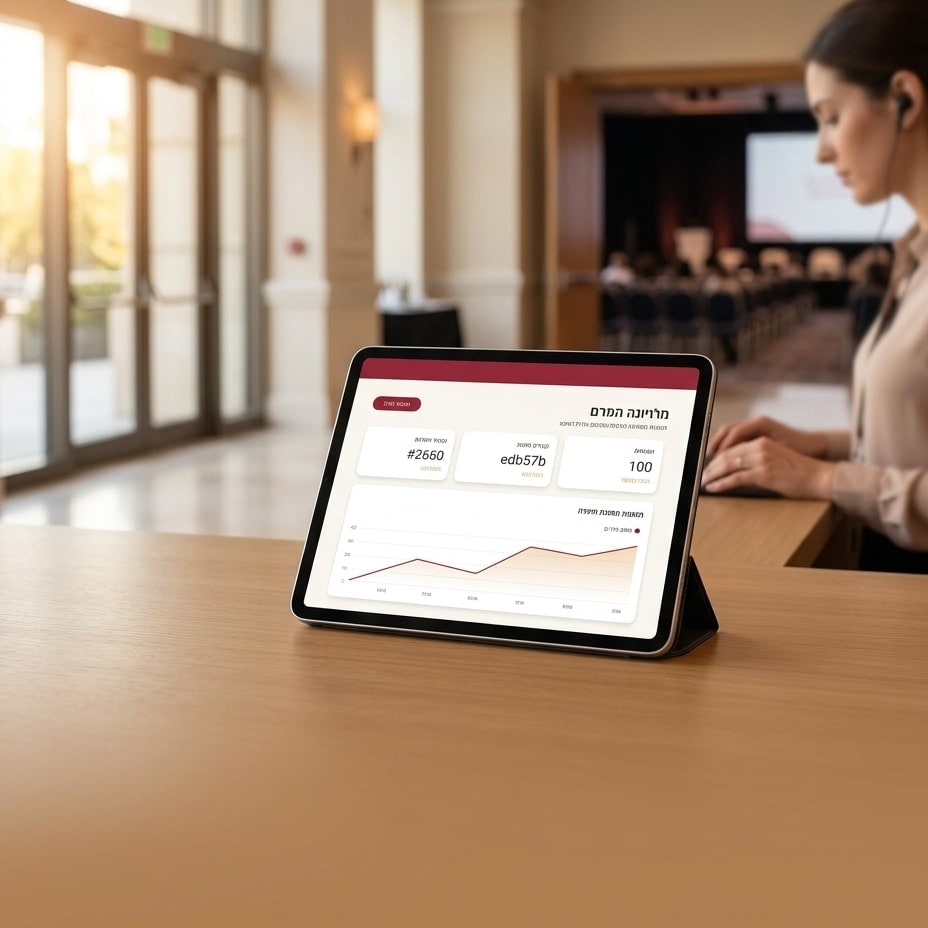
For many operations teams, that single question triggers an operational nightmare: consolidating local check-in files, manually cross-referencing entries, and eliminating duplicates. Generating an instant attendance report for stakeholders is no longer a luxury; it is the operational baseline that separates amateur production from enterprise-grade, data-driven event execution.
In this guide, we break down the operational architecture required to deliver a comprehensive, branded, and fully validated attendance report within minutes of closing the gates—without touching complex VLOOKUP formulas and without risking data integrity.
Why Post-Event Manual Spreadsheet Reconciliation Fails
Managing attendee verification across decentralized spreadsheets introduces systemic failure points into event operations. When entrance terminals operate in silos without continuous synchronization, critical issues compound quickly:
- Data Drift: The attendee manifest exported forty-eight hours before the conference rarely reflects the VIP additions and last-minute registrations approved on event morning.
- Duplicate Scans: Scanning the same attendee across multiple entrance points without real-time validation corrupts total headcount numbers and creates false attendance spikes.
- Processing Bottlenecks: Aggregating disparate records into a unified RFC 4180 CSV specification structure and computing summary metrics demands hours of manual parsing at the end of an exhausting production day.
Eliminating these points of failure requires routing all physical check-in activity into an integrated live attendance counter and zone-based access control setup that streams every scan directly into an authoritative Single Source of Truth (SSOT).
| Parameter | Traditional Manual Spreadsheets | Real-Time Cloud Synchronization |
|---|---|---|
| Report Generation Time | 4 to 24 hours | Under 60 seconds at push of a button |
| Data Accuracy | High risk of human error & duplicates | 100% verified via unique identifier |
| Zone Segmentation | Requires manual lookup across files | Automated via scanner ID & timestamp |
| Client Experience | Raw, unformatted spreadsheet | Branded, executive-ready summary document |
The Data Infrastructure: Delivering Real-Time Attendance Reports for Corporate Events
Producing automated, real-time client reports requires three architectural layers established well before doors open to attendees:
1. Ingestion and Deterministic Verification
Every registered participant must receive a Unique Identifier (UID) encoded into a dynamic QR Code. When a scanner reads the credential at the gate, the client application issues an ultra-low-latency verification request to the backend. Valid passes immediately update the guest record to Checked-In and log an immutable ISO 8601 Timestamp alongside the specific terminal ID.
2. Offline Synchronization Management
Convention centers and underground exhibition halls routinely suffer from cellular degradation or complete network drops. Check-in architectures must support localized, encrypted caching on the edge device with deterministic conflict-resolution protocols whenever connectivity resumes, aligning with the standards outlined in the MDN Web Docs offline documentation.
3. Aggregation and Instant Attendance Summary Generation
As the final entry window closes, the aggregation engine executes a pre-compiled summary query that generates key performance indicators:
- Show-up Rate: Actual attendees against total pre-registered capacity.
- Arrival Velocity: Check-in distribution over time to identify ingress peak loads.
- Attendee Segmentation: Granular breakdown across VIPs, sponsor delegates, staff, and general admission.
Rather than handing the client an unparsed data export, the system compiles these metrics directly into a branded, executive-level PDF complete with corporate branding, distribution graphs, and track engagement breakdowns—ready to deliver to the client's leadership before the venue clears out.
Three Practical Steps to Implement at Your Next Event
- Pre-Configure Custom Data Attributes: Ensure your initial guest list includes structured metadata—such as company, seniority tier, and ticket classification—so the final report delivers actionable business intelligence.
- Isolate Checkpoint Scanners by Zone: If your event includes concurrent tracks or exclusive workshops, assign dedicated scanners to secondary hall entrances to quantify track engagement, rather than just perimeter entry.
- Automate the Reporting Template: Design and test the summary template before the event begins, ensuring that delivering the completed analysis at the end of the day requires nothing more than a single export trigger.
Transitioning check-in data from static spreadsheets to live streaming data infrastructure eliminates manual overhead and establishes your team as an indispensable, technically sophisticated operational partner.
If you want to review your event access architecture or see how real-time reporting integrates with your upcoming production, contact our engineering team for an operational walkthrough.
Keep reading
Event Check-In Queue Management: Timing WhatsApp Tickets to Eliminate Bottlenecks
Eliminate check-in bottlenecks at high-capacity events with timed WhatsApp ticket delivery, local device caching, and real-time scanning synchronization.

Real-Time Attendance Tracking: Live Event Control and Zone Access
Learn how real-time attendance tracking and WebSocket sync enable live crowd control, zone management, and frictionless enterprise event operations.
How to Calculate Event Check-In Stations: 3 Operational Rules to Prevent Queues
Learn how to calculate event check-in stations using peak flow rates and service time formulas to eliminate registration queues at your next conference.